NXP’s new i.MX 937 application processor expands design vision
2026-06-01
i. The MX 937 System on Chip (SoC) balances high-performance edge AI with cost and power optimization design on a reliable and scalable platform.
Edge computing designers have long faced a dilemma: choose entry-level chips with insufficient performance or high-end processors with high prices. Due to the lack of intermediate solutions, both upward expansion and downward simplification of the design have become difficult and costly. With the change of design schemes and the expansion of product lines, engineers urgently need a microprocessor (MPU) product series with sufficient flexibility and scalability to meet their continuous development needs.
The newly launched i.MX 937 application processor by NXP can solve this dilemma. This intelligent and cost-effective solution is specifically designed for scalability in automotive, industrial, and IoT edge deployments. This device uses a quad core Arm ® Cortex ® A55 complex, integrated with dedicated NXP eIQ ® The Neutron Neural Processor (NPU) is pin compatible with the i.MX 95 and i.MX 952 series, helping you transform grand concepts into responsive, safe, cost optimized, and energy-efficient edge products.
Why choose the i.MX 937 application processor?
Today's designers are often trapped by rigid hardware architectures that are difficult to adapt to a wide range of application scenarios. When a project requires performance improvement or the addition of AI capabilities, existing solutions often mean a comprehensive redesign of high-risk, high cost printed circuit boards (PCBs). Many upgrade paths lack the pin compatibility and software compatibility required for efficient expansion of product lines. Therefore, as the product line expands, the team has to deal with the complex challenges of managing multiple software streams and disparate hardware layouts.
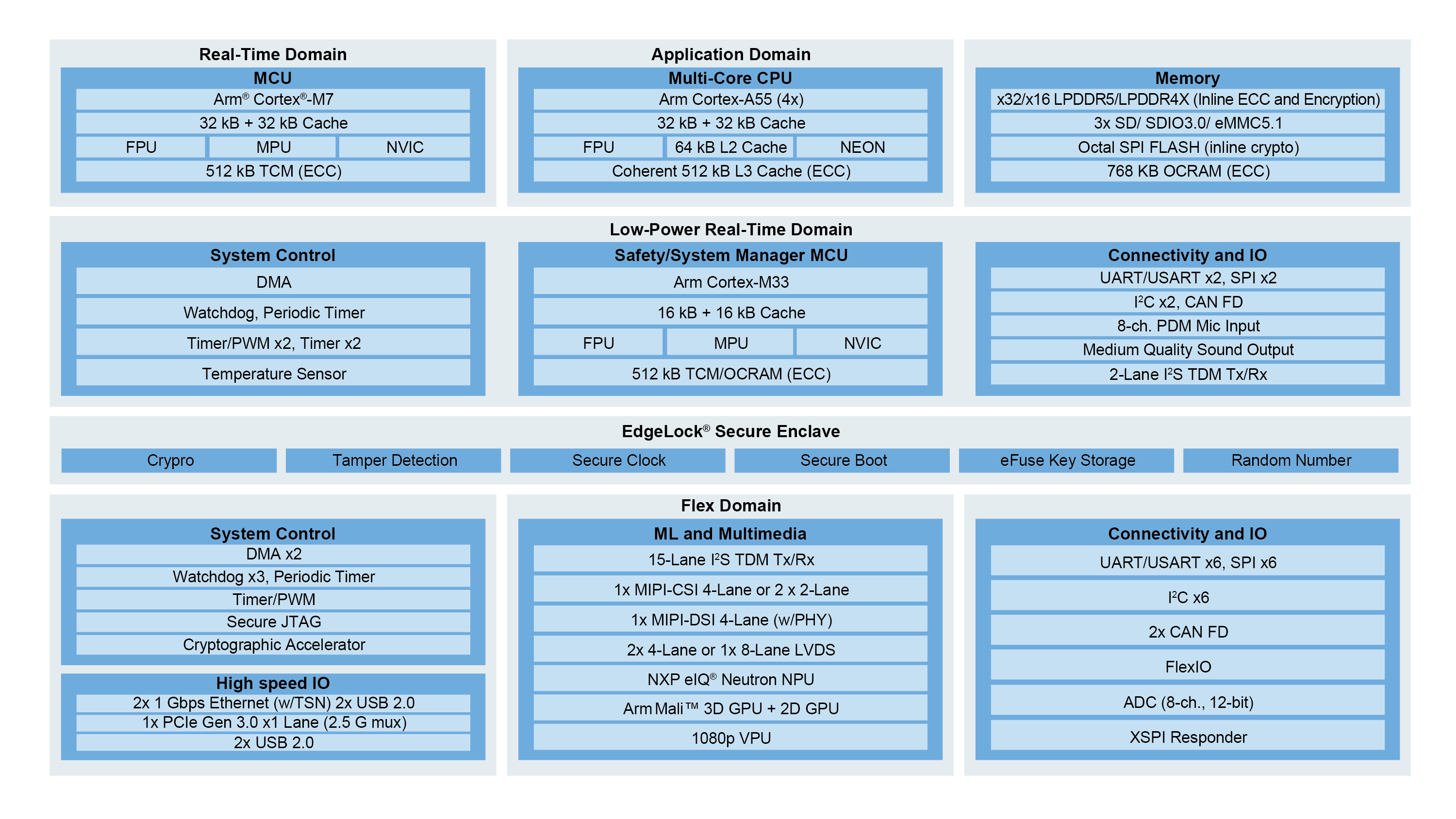 i. MX 937 Application Processor Block Diagram
i. The MX 937 processor helps to overcome the aforementioned bottlenecks. With compatibility with the i.MX 95 and i.MX 952 series, this processor allows you to design a single system that can improve or decrease performance. It has extremely high flexibility to help you accurately meet specific market needs without having to bear additional expenses from scratch, ensuring that your product portfolio is always ready for future challenges.
High performance multimedia and edge AI
i. MX 937 MPU aims to become a support for Linux ® The platform is suitable for modern human-machine interfaces (HMI) and edge AI applications. For this purpose, the device is equipped with a quad core Arm Cortex-A55 complex with a main frequency of 1.4GHz for application processing, a dedicated Arm Cortex-M7 with a main frequency of 667MHz for real-time workloads, and a low-power Arm Cortex-M33 core for system management tasks. This computing complex supports up to 4500MT/s of x16 or x32 LPDDR5 memory, or 3733MT/s of LPDDR4x memory, and integrates inline error correction code (ECC) and memory encryption functionality.
Its multimedia subsystem is equally powerful, integrating Arm ® Mali ™ G310 3D Graphics Processing Unit (GPU), as well as 1080p Video Processing Unit (VPU) that supports H.264 encoding and H.264/H.265 decoding. To support advanced visual applications, the chip is equipped with NXP eIQ Neutron NPU, which can provide machine learning (ML) acceleration capability of 2 eTOPS *. At the same time, it is also equipped with MIPI-CSI that supports RGB-IR, allowing designers to implement camera systems with minimal external components.
(* Note: eTOPs, also known as "equivalent TOPS", is a performance metric based on the average performance of the device relative to the i.MX 8M Plus application processor in multiple benchmark tests.). )
Overview of important parameters
• Four core Arm Cortex-A55, with a clock speed of up to 1.4GHz
• Arm Cortex-M7 real-time core with a clock speed of 667MHz
• Arm Cortex-M33 low-power system management core
• NXP eIQ Neutron NPU (2 eTOPS)
• Arm Mali G310 3D GPU
• 1080p60 H.265/H.264 decoding; H. 264 encoded VPU
• 4500 MT/s x16 or x32 LPDDR5, or 3733 MT/s LPDDR4x, integrated with inline ECC and memory encryption
• EdgeLock ® safety zone
• FCBGA packaging options compatible with i.MX 952 and i.MX 95 series
Maximizing scalability and minimizing investment
A major challenge that engineering teams often face is the fragmentation of development resources when switching between entry-level and high-performance models. Traditionally, product expansion means porting software to a new Board Support Package (BSP) and managing a completely different toolchain. With the i.MX 937 processor, you can access a unified development ecosystem that shares the same BSP, security architecture, and boot structure as the flagship i.MX 95 and i.MX 952 series. With just one software investment, you can achieve widespread deployment of the product across multiple performance levels.
At the hardware level, it also provides a scalable path. The cost optimized 15x15mm FCBGA package is compatible with the i.MX 952 series pins and is designed to support cost-effective 6-8 layer through-hole PCBs, while complying with typical automotive and industrial PCB design rules. The larger 19x19mm package is compatible with both the i.MX 952 and i.MX 95 series.
Actual application impact
i. With its powerful computing and multimedia performance, MX 937 brings intelligence to every corner of the automotive, industrial, and IoT fields.
car
i. The MX 937 processor is equipped with a powerful 3D GPU, making it an ideal choice for applications such as standalone car hosts, auxiliary displays, and two wheeler connected dashboards.
Industrial automation and robotics technology
The factory workshop requires robots that can perceive and respond in real-time while adhering to strict safety standards. i. The MX 937 provides the 3D graphics and NPU acceleration capabilities required for humanoid or mobile robots to perform object recognition and path planning. Supported by dual Gigabit Ethernet and Time Sensitive Network (TSN), this device ensures seamless synchronization between your industrial HMI and control system across the entire network.
Smart Home and Building Control
In the smart home ecosystem, the i.MX 937 processor can support building highly secure gateways or advanced HMI panels. Designers can use its display and camera interface to build high-resolution visual doorbells or security panels with local AI face tracking and voice assistant functions. At the same time, the integrated EdgeLock security zone can provide tight protection for sensitive user data at the hardware level.
Medical Health and Patient Monitoring
Medical instrument HMI has strict requirements for display reliability and real-time control capability to ensure patient safety. i. The MX 937 processor helps designers create high-resolution monitoring devices that monitor vital sign data in real-time and use edge AI technology to issue timely warnings to medical staff when abnormal situations are detected. Its secure boot mechanism and encryption acceleration function can effectively meet the strict regulatory requirements for patient data privacy protection.
i. Advantages of MX 937 processor
In summary, the i.MX 937 SoC has the following key features
• High cost-effective real-time processing and application computing capabilities for Linux systems
•Seamless compatibility with the i.MX 95 and i.MX 952 series
• Dedicated 2 eTOPS NPUs, supporting efficient edge AI and visual processing
•High performance 3D GPU and 1080p VPU create an immersive HMI experience
•Advanced hardware security protection achieved through EdgeLock secure zones
i. MX 937 enables you to build smarter products, achieve faster scalability, and ultimately deliver truly market leading products.
Are you ready to build the next design? Browse the i.MX 937 product page for detailed information.
Author:
Ross McLuckie
Manager of NXP Semiconductor Edge Processing Automotive Division
Ross McLuckie is currently the head of NXP's in car information services and automotive connectivity, based in Glasgow, Scotland. During his 25 years of service at NXP, Freescale, and Motorola, Ross primarily focused on the automotive industry. Initially working as an application engineer on 8-bit and 16 bit microcontrollers, he later ventured into a wide range of product lines across multiple markets, including focusing on in car information services and connectivity technology in his current position in recent years. Ross holds a degree in electrical and electronic engineering from Strathclyde University in Scotland.





 Karmin Electronic (HK) Limited
  Hong Kong Tel:852-39070580 96557277
 Hong Kong Fax:852-39070581
 Email:
 Hong Kong address: Room 6, 11th floor, Huali industrial center, 10 - 14guidi street, Fo Tan, New Territories, Hong Kong