Vishay推出透射式传感器,为工业和消费电子应用提供更大设计灵活性
2026-03-16
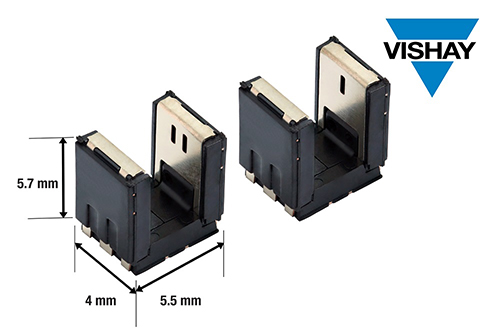
Single channel and dual channel devices are packaged in compact 5.5 mm x 4 mm x 5.7 mm SMD packages, suitable for position sensing and optical coding applications
MALVERN, Pennsylvania, USA, Shanghai, China - March 12, 2026- Vishay Intertechnology, Inc. (NYSE stock code: VSH) announced the launch of two new surface mount devices, VT171P and VT172U, expanding its line of transmissive sensor products to meet the needs of industrial, consumer electronics, and communication applications. Vishay Semiconductors single channel VT171P and dual channel VT172U are packaged in a compact 5.5 mm x 4 mm x 5.7 mm package, with a dome lens height that is 42% higher than the previous generation of industrial devices.
The recently released device has increased the height of the dome, which helps improve the flexibility of mechanical design and provides greater vertical space for large coding wheels in spinning applications. Two devices can be used as position sensors for encoders, suitable for industrial automation systems, drive devices, and tools; Consumer entertainment products, home appliances, and healthcare equipment; Switches, relays, and antennas; Mobile broadband router. Two sensors can detect motion and speed. The dual channel VT172U can also be used for detecting direction.
The single channel VT171P includes an infrared emitter and a photosensitive tube detector, which are arranged relatively in a surface mount package. The dual channel VT172U includes one infrared emitter and two photosensitive tube detectors. The typical output current of the two sensors is 1.5 mA, with a working wavelength of 950 nm. The device has a notch width of 3 mm, an aperture of 0.3 mm, and rapid rise and fall times of 14 μ s and 21 μ s, respectively.
The moisture sensitivity of VT171P and VT172U reaches level 1 (MSL1) and can be stored in the workshop for a long time. The device can use JEDEC-STD-020 lead-free (Pb) reflow soldering process, halogen-free, and comply with RoHS and Vishay green standards.
The transmission sensor can now provide samples and has achieved mass production, with a supply cycle of 10 weeks.



 Karmin Electronic (HK) Limited
  Hong Kong Tel:852-39070580 96557277
 Hong Kong Fax:852-39070581
 Email:
 Hong Kong address: Room 6, 11th floor, Huali industrial center, 10 - 14guidi street, Fo Tan, New Territories, Hong Kong