Transcend Launches CXL AIC Expansion Card: Up to 256GB of Memory for Compatible Devices
2026-02-25
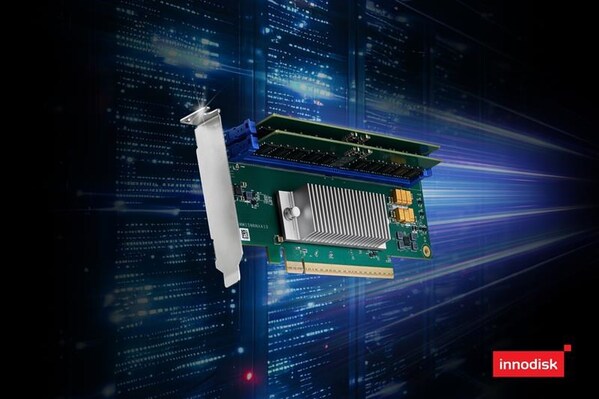
Global leader in embedded storage and industrial memory, Innodisk, announced the launch of its new CXL AIC expansion card (Add-in Card). Designed with CXL architecture, this product utilizes a standard PCIe Gen 5 x8 interface to provide up to 256GB of additional memory capacity without occupying traditional DIMM slots, while delivering high bandwidth of up to 32GB/s and ultra-low latency transmission performance.
Innodisk Launches CXL AIC Expansion Card
Additionally, the UDIMM CXL AIC expansion card adopts a HHHL (half-height, half-length) compact form factor, specifically designed for edge computing environments with limited space. It supports two standard-height or VLP (ultra-low-profile) DDR5 RDIMM memory modules, effectively saving internal chassis space and enabling edge servers and systems to overcome existing hardware architecture limitations while seamlessly addressing the growing memory demands of edge AI and real-time computing scenarios.
CXL offers low latency and high bandwidth, empowering edge applications such as 5G communication, high-frequency trading, and micro data centers
R1: "Edge computing" must be translated as "edge computing" With the rapid development of applications such as 5G communication, AI inference, and real-time data processing, edge systems are simultaneously facing multiple challenges, including transmission latency, traffic fluctuations, and limited deployment space. Meanwhile, the demand for memory capacity and performance continues to rise, but constrained by motherboard design, the number of traditional DIMM slots has gradually become a bottleneck for memory expansion. Against this backdrop, PCIe, as a mature and universal interface standard in edge systems, is emerging as a key breakthrough for achieving memory expansion. Transcend has long been deeply involved in the memory market, continuously strengthening mainstream product specifications while also actively exploring cutting-edge technologies required for next-generation computing architectures based on an in-depth understanding of edge AI application scenarios. The goal is to develop innovative solutions capable of addressing future computing power challenges. The Transcend CXL AIC expansion card is a significant achievement under this strategy—integrating CXL architecture with "Add-in Card" (expansion card) design, it can directly utilize existing PCIe slots to achieve memory expansion, effectively breaking through the memory limits of traditional system architectures and providing more flexible, efficient, and scalable hardware foundations for edge computing.
R1: "Edge computing" must be translated as edge computing.
The Transcend CXL AIC expansion card adopts a PCIe Gen5 x8 interface, providing the system with up to 32GB/s of additional bandwidth and effectively reducing transmission latency between the CPU and memory. It is particularly suitable for edge computing scenarios with stringent requirements for real-time performance and low latency, including applications such as 5G communication, high-frequency financial trading (HFT), micro data centers, and intelligent medical imaging.
Additionally, this expansion card supports the CXL 2.0 Type 3 (CXL.mem / CXL.io) protocol, enabling memory pooling and resource sharing. It allows the system to dynamically allocate memory resources among multiple hosts based on actual workloads, maintaining high performance while further improving the overall utilization efficiency of computing resources.
Zhang Weimin, General Manager of Yiding International DRAM Business Unit, said, "The introduction of CXL AIC expansion card reflects our deep layout of AI edge computing. The pursuit of edge systems is not to stack hardware on a large scale like in the cloud, but to provide elastic scaling solutions that can fit specific application scenarios, balance small size, low latency, and high energy efficiency. Different from general memory products, Yiding has long been deeply involved in the field of industrial control and actively expanding edge AI applications, building a diversified product line through forward-looking technology research and development. The CXL AIC expansion card launched this time will help customers complete system upgrades in a more cost-effective way, comprehensively addressing the computing power challenges brought by low latency applications and AI inference. "
Responding to the demand for advanced computing power from cloud to end, improving the layout of CXL products
The exquisite HHHL exterior design enhances the flexibility of memory configuration for edge deployment
The Yiding CXL AIC expansion card adopts a compact HHHL design, which can be easily integrated into various systems. Users can install DDR5 RDIMM memory modules of different capacities according to their actual needs, achieving highly flexible hardware configuration and supporting up to 256GB of memory expansion. For small edge systems with more limited space, the Yiding DDR5 RDIMM VLP (ultra short version) memory module can also be optionally selected, effectively saving internal space of the chassis, improving wiring freedom and overall deployment flexibility.



 Karmin Electronic (HK) Limited
  Hong Kong Tel:852-39070580 96557277
 Hong Kong Fax:852-39070581
 Email:
 Hong Kong address: Room 6, 11th floor, Huali industrial center, 10 - 14guidi street, Fo Tan, New Territories, Hong Kong